

Furnace Prices: Gas Furnace Installation Cost In Vancouver

Here are some ballpark prices for installing a gas furnace in Vancouver BC:

Basic 90-93% efficient furnace, budget installation: $4000
95% efficient two-stage furnace: $4800
95% efficient variable speed furnace:  $5300
95-98% efficient variable capacity furnace: $5800

• These are only ballpark estimates for an average home. Actual costs can vary widely depending on your home’s requirements, the contractor selected, present equipment costs, market conditions, and several other factors.

• These are approximations of what you should expect to pay for an installation by a reputable, established contractor who performs quality work. You can get a furnace installed for less if low price is your primary concern.

• These estimates do not include add-ons such as advanced filtration systems, advanced programmable thermostats, humidifiers, etc.

To determine the actual cost to install a furnace in your home, call 604 GOOD GUY (604 466 3489) to schedule your free in-home quotation. Or use our online form.

Visit our furnaces page to learn more about your options for installing a new furnace (such as the difference between single stage, two-stage, variable speed, and variable capacity).

Posted in Uncategorized | Leave a comment

Environment Canada: Hot Summer Forecasted For Canada (Including Vancouver)

Environment Canada has just released their most recent forecast for the summer, and they’re calling for a hot summer across Canada, including the Greater Vancouver area!

Summer 2012 Weather Forecast

You can check out the forecasts at http://www.weatheroffice.gc.ca/saisons/index_e.html .

They admit that their long-range forecasts are only somewhat more accurate than chance, but quotes on air conditioners are free (except for apartments) so call and schedule yours today!

Posted in Uncategorized | Leave a comment

CMHC Study: Tankless water heaters use 46% less gas than hot water tanks

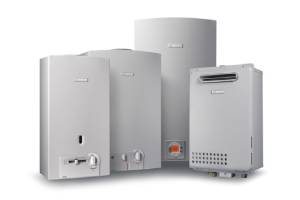
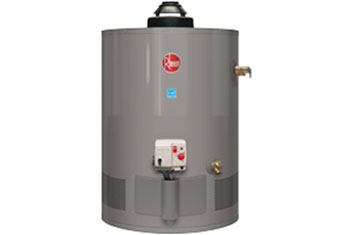
The Energy Factor (EF) rating system provides a means of comparing the efficiency of hot water heating systems. Hot water tanks, for example, have EFs ranging from about 0.53 to 0.62 (the minimum energy factor of a 40 gallon gas tank in BC was raised to 0.62 in 2010). This means that only 53% to 62% of the heat generated is actually used, while the rest is lost to standby losses (heat lost while the tank is not in use) and out the chimney (due to the inefficiency of the burners). This compares to the EF ratings of between 0.80-0.98 for tankless water heaters, which should provide energy savings ranging from 23% to 46% compared to hot water tanks (see image).

tankless water heater efficiency

However, the EF ratings are based on equipment tests conducted in a laboratory setting, and it was unknown how accurately they predicted real world performance.

The Canadian Mortgage and Housing Corporation (CMHC), in cooperation with Enbridge Gas, recently conducted a study on the real world performance of tankless water heaters. In 23 Toronto homes, hot water tanks were replaced with tankless units and the amount of gas used for hot water heating was measured before and after.

The result was an average energy savings of 46%, which is higher than predicted by the EF ratings. However, savings varied widely, from as low as 2% to as high as 66%. Much of this variation was due to changes in the amount of water used. For example, the household that only saw a 2% decrease in energy usage had increased their hot water consumption by 51% after installing the tankless unit, which still indicates a significant increase in efficiency.

tankless water heater energy savings

On average, homes increased their water consumption by 2% after installing the tankless systems (although this varied widely from as much as a 31% decrease to a 62% increase). Yet the results still suggest that few homeowners greatly increase their water consumption after installing a tankless system (only 2 homes showed more than a 30% increase).

Due to the current low price of natural gas, installing a tankless system would only be expected to save $69 on gas per year. However in some homes the annual savings could be $150 or more. Tankless systems usually cost $2000 to $4000, compared to the approximate $1000 cost of a hot water tank. This means that the payback on a tankless system can be as little as 7 years, but is typically 20 years or more (basically the life of the system).

Homeowners stated that they liked the unlimited supply of hot water, but many did not like the delay in the supply of hot water to the tap (which varies according to the tankless installation, but was reported to average 20 seconds in this study).

Tankless systems also offer several other advantages such as longer life and lack of corrosion (see our tankless water heaters page for details).

The full report can be downloaded at http://www.cmhc-schl.gc.ca/odpub/pdf/67548.pdf?fr=1336131516776

UPDATE: A similar study was performed by the Minnesota Office of Energy Security and produced similar results. The authors suggested that the higher than expected energy savings provided by tankless units could be because the laboratory tests used to determine EF do not represent typical usage in a real home (the testing only involves 6 uses of hot water per day, while usage is more frequent in most homes). The authors estimate hot water tank ratings are overestimated by 23% while tankless units are only overestimated by 10%. ASHRAE is currently developing a new testing procedure for water heaters. You can download the 91 page Minnesota report here.

Posted in Uncategorized | Leave a comment

Heat recovery ventilators now required in all new Vancouver homes

With the City of Vancouver’s Green Homes Program, new homes are required to be better insulated with less air leakage than ever before. This means lower heating costs. Unfortunately, it can also lead to stuffy, stale indoor air.

To prevent this, the City is now also requiring a heat recovery ventilator (HRV) to be installed in every new home.

An HRV delivers fresh outdoor air into a home’s ventilation system while also exhausting stale outdoor air. But, unlike with other ventilation systems, operating an HRV results in very little energy loss. This is because an HRV will transfer the heat from the outgoing stale air into the incoming fresh air. It does so by passing the air through a countercurrent heat exchanger, where the air flowing in each direction is passed through an array of narrow passages. As the outgoing indoor air flows through the narrow passages, its heat is transferred into the incoming outdoor air. Up to 90% of the heat can be saved.

In short, an HRV is an energy efficient way to keep your home’s air fresh.

All BC homeowners who have not already received a LiveSmart BC grant can receive a $800 grant when they install an HRV in an existing home.

Posted in Uncategorized | Leave a comment

ecoENERGY program closed early to new participants

Last summer, the federal government announced the ecoENERGY program would be renewed until March 31st, 2012. But they also announced that it would be available to only 250,000 homeowners. On January 28th, it was announced that 250,000 homeowners had registered to begin the program. If you have not already registered for the program, you are not eligible to receive grants.

If you have already registered for the program, you have until March 31st to complete your pre-retrofit evaluation and your renovations. Then you have until June 30th to complete your post-retrofit evaluation. The grants available can be seen at http://oee.nrcan.gc.ca/residential/personal/retrofit/4171.

The LiveSmart BC program is still available until March 31st, 2013 (or until funding is depleted). See our grants & rebates page for details.

Posted in Uncategorized | Leave a comment

The ecoENERGY program is almost over & will not be renewed!

With the federal government’s ecoENERGY program, homeowners can receive a grant of up to $5000 when they improve their home’s energy efficiency. The program has been running since 2007 (except for a suspension between April 2010 and June 2011), but is scheduled to end on March 31st, 2012. To receive your grant, you must complete your renovations and have both a pre- and post-retrofit evaluation performed before this date.

But if you’re hoping the program will be reinstated it looks like you’re out of luck. Although both the federal ecoENERGY and the provincial LiveSmart BC program have been suspended and resumed before, it looks like this really is the end of federal grant programs.

In a July interview with CBC News, Natural Resources Minister Joe Oliver stated that the government will focus on its deficit reduction targets and will not renew the program. And, since the program will only be available to a limited number of homeowners, it may end even earlier than the intended March 31st end date. Mr. Oliver urges homeowners who wish to take advantage of the program to do so as soon as possible.

Some of the largest grants are for new heating & air conditioning systems: including up to $790 off a new high efficiency furnace, $750 off a high efficiency boiler, and $500 off an air source heat pump.

These can be combined with LiveSmart BC grants to save up to $1390 off a new furnace or boiler and up to $2890 for a heat pump + furnace combo.

See Good Guy’s grants and rebates page for details, or call 604 GOOD GUY (604 466 3489) to schedule a free in-home quotation on a new system.

Posted in Uncategorized | Leave a comment